
|
This diagram shows a model of Sir Karl Popper (Popper, 1972). The arrows between boxes are intended to indicate the direction of information transfer. Popper was concerned with providing a conceptual and logical framework for scientific knowledge, without the "progressivist" assumption that the development of science can be measured as the extent to which it approaches "the truth" - whatever that may be. Thus, in Fig. 11, there is no direct connection between human knowledge ("World III") and the real world ("World I"). Nevertheless, World III may be modified by means of comparison of experience ("World II") with the expectations, derived from World III, that determine our perceptions. Conversely, there is a weaker sense in which the external world may be modified as a result of our perception of it: the arrow from World II to World I may indicate the selection of particular experiences, since all observation is guided expectation, though it could also be interpreted as changes that we make to our environment as a result of our knowledge of it. |
|
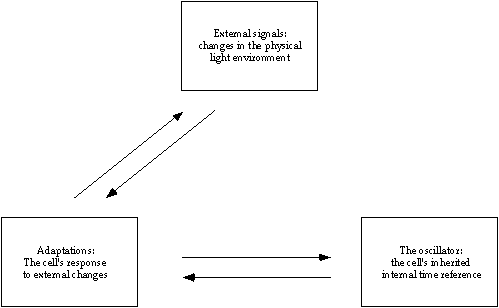
This diagram show a simple translation of Popper's model into terms more specifically relevant to the topic of this symposium. Again, the arrows indicate direction of information transfer. In place of World I, the lower diagram has changes in the light environment. Adaptations then consist not merely of "blind" responses to external changes, but of responses that arise in some way from the outcome of a comparison of the external signal with the internal reference provided by the oscillator or clock. Transient shading might thus be distinguishable from sunset, for example, and progressive changes in daylength might be identifiable as such, and correlated with seasonal changes in, for example, temperature. In the lower diagram, the arrow rising from left to right indicates the cell's or organism's ability to carry out changes - adaptations - that tend to restore its immediate physical environment and eliminate the need for further adaptation. If a physiological adaptation fails to do this, the internal time reference might arbitrate in the deployment of an equivalent developmental adaptation: trees do not shed their leaves at dusk. |